

Since the dawn of the Industrial Revolution, the world has celebrated specialization. Factories needed workers for one task, not ten. Businesses built departments. Nations optimized sectors. The trend was clear: go deep, not wide.
And for a while, it worked. Specialization created unprecedented productivity and technical breakthroughs. But it also came at a cost — the sidelining of the generalist.
The generalist, the one who sees the big picture, who connects dots across disciplines, who understands human dynamics as well as market forces — gradually became “too broad” for job descriptions. In a world that wanted experts, the generalist was often seen as “not enough.”
But something extraordinary is happening.
We are entering a new revolution — this time powered not by steam or electricity, but by artificial intelligence. And with it, I believe we’re witnessing the renaissance of the generalist.
Why AI favors the generalist?!
Here’s the paradox: AI provides specialists’ knowledge at our fingertips, instantly. You can ask an AI to analyze a medical scan, write legal copy, draft code, or explain quantum theory. The bottleneck is no longer access to information — it is the human capacity to ask the right questions and synthesize answers across domains.
That’s where the generalist shines.
Generalists are translators between worlds. They’re the bridge between business and engineering, between marketing and psychology, between culture and economics. And now, with AI as their assistant, they can dive deeper than ever before — without becoming stuck in the trenches.
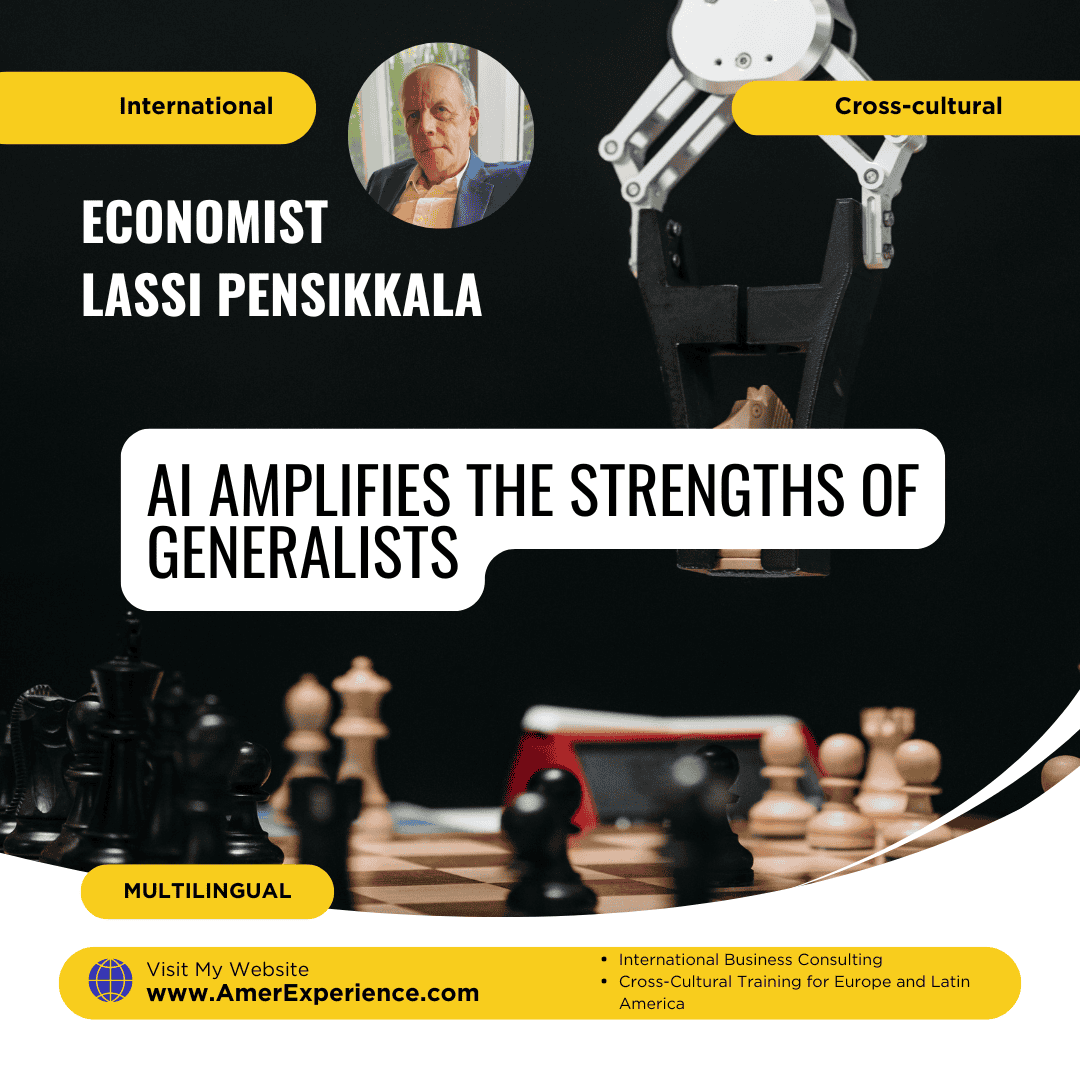
AI amplifies the strengths of generalists:
- Strategic vision
- Cross-disciplinary thinking
- Human judgment
- Adaptability
- Storytelling and synthesis
Where once generalists were accused of knowing “a little about a lot,” now they can know a lot about a lot — supported by the depth of AI.
From undervalued to indispensable
As someone who has worked across industries and continents — from international trade to digital marketing, from travel to insurance — I’ve always seen my generalist nature as both a strength and a challenge. There were times when I felt out of place among hyper-specialists. But I kept building bridges, spotting opportunities, and creating value.
Now, with AI integrated into my daily work, I see my role not diminished but empowered. I can move faster, go deeper, and connect ideas across boundaries like never before. AI doesn’t replace me — it extends me.
And I believe the same is true for every generalist reading this.
Inductive and deductive thinking — A scientific lens on generalists and specialists
As we learned during our studies at the University of Hamburg, Germany — and as many students around the world have encountered — the foundation of scientific thinking lies in two essential approaches: inductive and deductive reasoning.
- Deductive reasoning starts with a general theory or principle and tests it in specific situations. It’s systematic, structured, and focused — much like the work of specialists.
- Inductive reasoning, on the other hand, observes specific phenomena and draws broader conclusions. It’s exploratory, open-ended, and synthesizing — the domain of generalists.
In science, both methods are indispensable. One without the other leads to blind spots.
And the same is true in society, business, and now AI-powered innovation.
Generalists are natural inductive thinkers. They observe, connect, and abstract meaning across fields. Specialists thrive in the deductive process, applying established methods to test and optimize.
With the rise of AI, the balance between these two approaches is shifting. Generalists, supported by AI-powered detail retrieval, can now combine inductive insight with deductive precision. This convergence is what makes them so powerful in today’s dynamic environment.
In a way, the scientific method is no longer reserved for laboratories — it’s becoming the logic of leadership, strategy, and innovation.
Pragmatic thinking: Experience still matters
While AI and reasoning models help us navigate complexity, one timeless skill must not be forgotten: pragmatic thinking.
I’ll never forget a story from my youth in Finland. My father was a constructor — hands-on, detail-oriented, but always grounded in reality. One day, an engineer from the municipality came to inspect a building my father was constructing. The engineer pointed critically at a structural element on the blueprint, claiming something was off. My father calmly asked him to turn the drawing around — the man had been reading it upside down.
Perspective matters.
And it’s often the experienced, practical thinker — the generalist, the builder, the entrepreneur — who catches what the overly technical eye can miss.
That lesson stayed with me. Today, even as we use AI tools and digital systems, we must remember: real-world experience, common sense, and human perspective remain irreplaceable.
Advice to my fellow generalists
- Use AI as your team of specialists — It can be your analyst, your coder, your legal advisor, your copywriter. Learn to prompt wisely.
- Focus on integration — Your unique value is not in knowing everything, but in connecting the big data.
- Trust your experience — Your pragmatic judgment, intuition, and worldview are more important than ever.
- Stay curious — Generalists thrive on learning. AI removes the barriers to access — use it to keep expanding.
- Lead — The future belongs to those who can guide others across complex landscapes. Step up.
In a world flooded with data, it is no longer the one with the most knowledge who wins — but the one who can see clearly, think across systems, and make wise decisions. Generalists, this is our moment.
”The Industrial Revolution might have sidelined us, but the AI revolution brings us back to the center stage.”
Let’s lead with vision, wisdom, and collaboration.
Thanks for reading,
Lassi Pensikkala
Economist, International Business Developer
Samborondón, Ecuador

Read more articles from Lassi Pensikkala

Hitting the green and growing your network: Why golf is a Hole-in-One for business
Lassi Pensikkala discusses how golf serves as an effective networking tool, allowing professionals to forge connections in a relaxed environment. Industry-specific outings enhance relationship-building, offering…
Keep reading
Warum Ihre persönliche Marke über Grenzen hinweg zählt
English | Deutsch | Español | Business Travel Magazine Jeder Berufstätige hat eine persönliche Marke, ob bewusst aufgebaut oder nicht. Für Unternehmer und Berater, die grenzüberschreitend arbeiten, wiegt diese Marke besonders…
Keep readingPor qué su marca personal cruza fronteras
English | Deutsch | Español | Business Travel Magazine Todo profesional tiene una marca personal, la haya construido deliberadamente o no. Para emprendedores y consultores que trabajan a través de fronteras,…
Keep readingBusiness Success: How to Harness the Power of Your Personal Brand
English | Deutsch | Español | Business Travel Magazine Why Your Personal Brand Matters Across Borders Every professional has a personal brand whether they’ve built…
Keep reading
Adidas invested in Finnish sustainable fibre firm Spinnova
🍷 Luxury experiences & tours in Finland ↗ — premium Nordic activities, Arctic adventures & curated excursions, powered by Viator Spinnova and Adidas: What Happened…
Keep reading
Ecuador Business Travel Guide: Opportunities, Business Culture & Executive Insights
Ecuador Business Travel Guide -,Ecuador, often overlooked as a business destination in Latin America, offers international executives unique advantages with its compact geography, dollarized economy,…
Keep readingSomething went wrong. Please refresh the page and/or try again.
AmerExperience Business
Explore international business consulting, executive insights, cross-cultural business, entrepreneurship, management, marketing and practical resources from the AmerExperience Business hub.
